Note
Go to the end to download the full example code
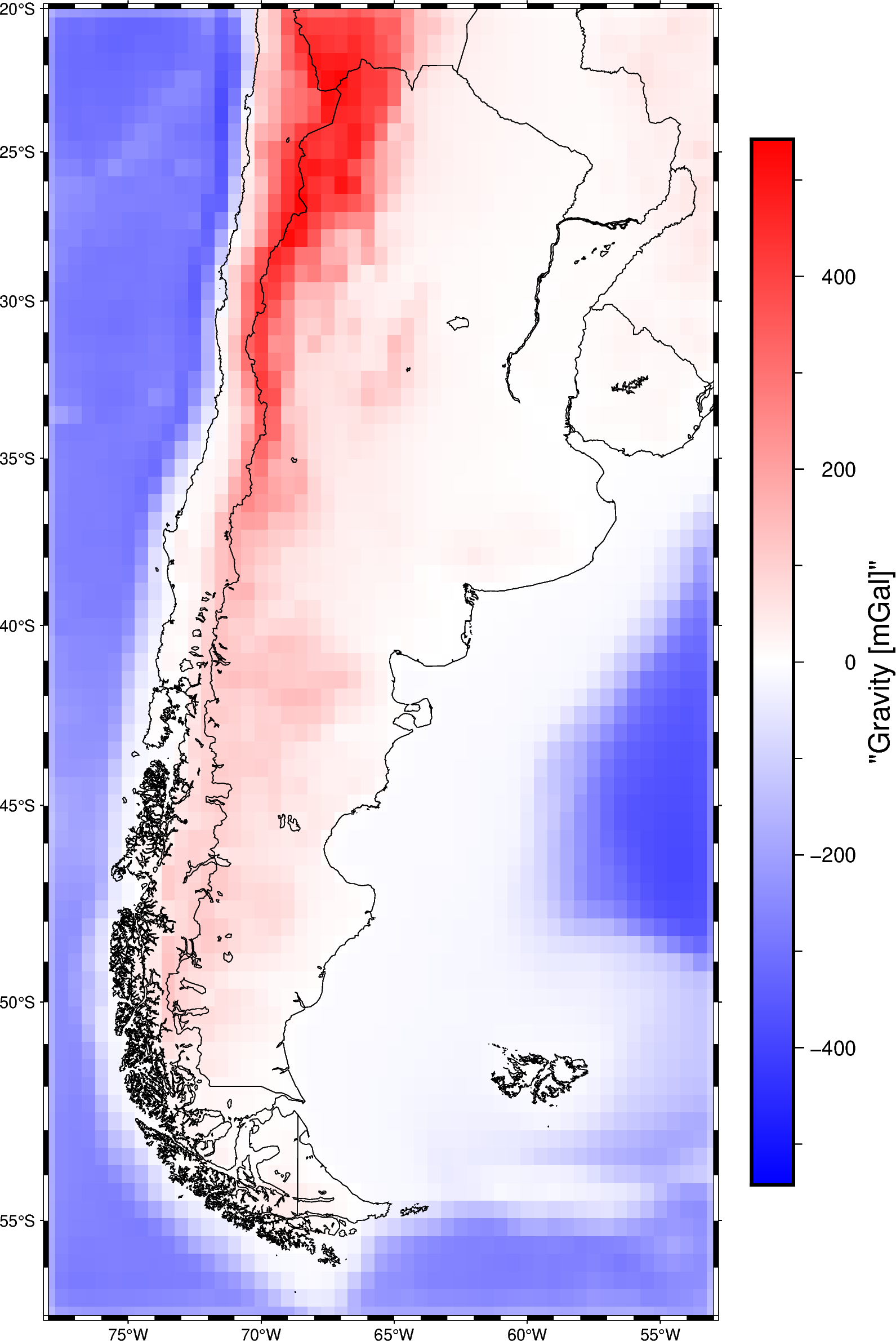
Layer of tesseroids#
import boule as bl
import ensaio
import numpy as np
import pygmt
import verde as vd
import xarray as xr

import harmonica as hm

fname = ensaio.fetch_earth_topography(version=1)
topo = xr.load_dataarray(fname)

region = (-78, -53, -57, -20)
topo = topo.sel(latitude=slice(*region[2:]), longitude=slice(*region[:2]))

ellipsoid = bl.WGS84

longitude, latitude = np.meshgrid(topo.longitude, topo.latitude)

# Compute radius of WGS84 ellipsoid at each lat/lon coordinates
reference = ellipsoid.geocentric_radius(latitude)

# Compute surface topography with respect to the center of the Earth
surface = topo + reference

# tesseroids above sea level have density of 2670 kg/m³ and tesseroids located below sea
# level have density of -1630 kg/m³
density = xr.where(topo > 0, 2670.0, 1040.0 - 2670.0)

# Create a layer of tesseroids representing the topography
# These have tops and bottoms defined by Earth's topography with respect to the center
# of the Earth.
tesseroids = hm.tesseroid_layer(
    coordinates=(topo.longitude, topo.latitude),
    surface=surface,
    reference=reference,
    properties={"density": density},
)

# Create a regular grid of computation points located at 10km above reference
grid_longitude, grid_latitude = vd.grid_coordinates(region=region, spacing=0.5)
grid_radius = ellipsoid.geocentric_radius(grid_latitude) + 10e3
grid_coords = (grid_longitude, grid_latitude, grid_radius)

# Compute gravity field of tesseroids on a regular grid of observation points
gravity = tesseroids.tesseroid_layer.gravity(grid_coords, field="g_z")
gravity = vd.make_xarray_grid(
    grid_coords,
    gravity,
    data_names="g_z",
    dims=("latitude", "longitude"),
    extra_coords_names="radius",
)

fig = pygmt.Figure()

# Plot tesseroid thickness
fig.grdimage(
    tesseroids.top - tesseroids.bottom,
    projection="M15c",
    nan_transparent=True,
    cmap="viridis",
    frame="+tTesseroid thickness",
)
fig.basemap(frame=True)
fig.colorbar(frame="af+lthickness (m)")
fig.coast(shorelines="0.5p,black", borders=["1/0.5p,black"])

fig.shift_origin(xshift="17c")

# Plot gravity field
maxabs = vd.maxabs(gravity.g_z)
pygmt.makecpt(cmap="balance+h0", series=(-maxabs, maxabs))
fig.grdimage(
    gravity.g_z,
    projection="M15c",
    nan_transparent=True,
    cmap=True,
    frame="+tForward gravity",
)

fig.basemap(frame=True)
fig.colorbar(frame="af+lgravity (mGal)")
fig.coast(shorelines="0.5p,black", borders=["1/0.5p,black"])
fig.show()
Total running time of the script: (0 minutes 23.893 seconds)