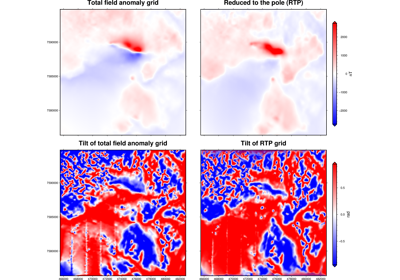
harmonica.tilt_angle#
- harmonica.tilt_angle(grid, *, pad=True, pad_kwargs=None)[source]#
Calculate the tilt angle of a potential field grid.
Compute the tilt of a regular gridded potential field \(M\). The horizontal derivatives are calculated through finite-differences while the upward derivative is calculated using FFT.
- Parameters:
- grid
xarray.DataArray A two dimensional
xarray.DataArraywhose coordinates are evenly spaced (regular grid). Its dimensions should be in the following order: northing, easting. Its coordinates should be defined in the same units.- padbool,
optional If True, will add padding to the grid before taking the Fourier Transform and applying the filter and remove it after the inverse Fourier Transform. Adding padding usually helps reduce edge effects from signal truncation. Default is True.
- pad_kwargs
dictorNone,optional Any additional keyword arguments that should be passed to the
xarray.DataArray.padfunction in the form of a dictionary. If none are given, the default padding of 25% the dimensions of the grid will be added using the “edge” method.
- grid
- Returns:
- tilt_grid
xarray.DataArray A
xarray.DataArraywith the calculated tilt in radians.
- tilt_grid
Notes
The tilt is calculated as:
\[\text{tilt}(f) = \tan^{-1} \left( \frac{ \frac{\partial M}{\partial z} }{ \sqrt{ \left( \frac{\partial M}{\partial x} \right)^2 + \left( \frac{\partial M}{\partial y} \right)^2 } } \right)\]where \(M\) is the regularly gridded potential field.
References